Mary – The Surrendered
Cast Characters for Christmas - Part 1
(Mary demonstrates the humility of a surrendered heart and life to the Lord, and serves for us an example of what sweet surrender looks like.)
Luke 1:26-56
Christmas is a special time of year… For centuries, Christians have made much-to-do about Christmas. Christmas is a special time each year when Christians remember and celebrate the love God demonstrated toward us, in the sending of His Son!
Throughout the year, we make much-to-do about Jesus' life, death, and resurrection! We are also, as discussed in recent weeks, to remain focused on His return one day! But, it is also appropriate, and important to reflect upon the significance of His birth! The Christmas story is to be celebrated. It is a holiday born in the church, but sadly,... like other special days, it has been hijacked by the world, and turned into something other than what it was intended – something less than it was intended…
Throughout the centuries, Christians have celebrated Christmas by borrowing and developing…
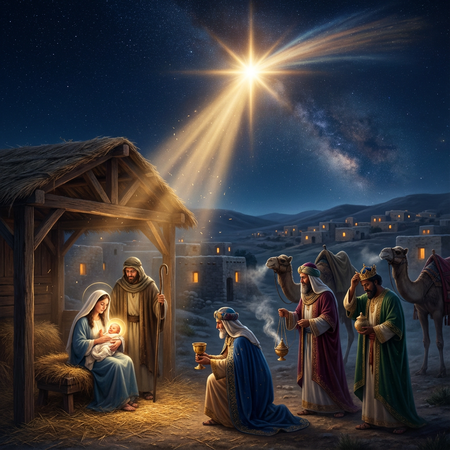
First, we developed traditions involving manger scenes with Mary and Joseph, angels, a star, shepherds, and even wise men with their gifts and camels…
And, we have been guilty of borrowing – borrowing elements from various cultures and adapting them into the celebration of Christmas… How else did Christmas trees, ornaments, and mistletoe become a part of celebrating Christmas?... In fact, through the years, the attention given to buying gifts, sending Christmas cards, adorning houses and lawns, and even making fruitcake – along with a host of other practices – have, for too many of us, become … distractions, rather than aids in helping us celebrate Christmas…
Christmas is a time to celebrate. Christians celebrate God's gift of Christ, and we celebrate God's gift in Christ… Christmas is the story that needs to be told every year!
John MacArthur – "[T]he non-negotiable reality that we celebrate at this time of the year is that the eternal God, the infinite, transcendent, all-knowing, all-powerful, all present, everlastingly unchanging, eternal God of the universe became a human being."
Over the next three weeks, I want to return to the narrative of the birth of our Savior and look at three different … characters that God employed in bringing about Christmas… We are going to look at three different characters associated with Christmas… No – this is not a study about Santa, the reindeer, or the Christmas tree. This is a look at three characters told about in the Scriptures that God… assembled to bring about Christmas!
Mary is a key character in this story. Joseph plays a not-so-small role as well… The shepherds that always have a role in every Christmas pageant, also play a significant role on the night of Jesus' birth. Over the next three weeks, we will take a closer look at these three cast characters God chose in bringing us Christmas…
Today, we are going to take a closer look at Mary. Initially, this is a thematic message about Mary, but we will settle in on something Mary says and look to that passage for the substance of today's message…
Let's begin by thinking about –
1. The Person of Mary
What do we know about Mary? Let's quickly review our text –
Luke 1:26-27
26 Now in the sixth month [from the context, we know that Luke is referring to the sixth month of Elizabeth's pregency…] the angel Gabriel was sent from God to a city in Galilee called Nazareth, 27 to a virgin engaged to a man whose name was Joseph, of the descendants of David; and the virgin's name was Mary.
From our text we learn some things about Mary –
She was a Galilean
Luke 1:26
26 Now in the sixth month the angel Gabriel was sent from God to a city in Galilee called Nazareth,
Mary was from the Galileen town of Nazareth.
Galilee was the region north of Israel, actually known as "Galilee of the Gentiles"... It is significant that this detail is included in the narrative… MacArthur explains this point better than I –
John MacArthur – "Nazareth was not on any of the major trade routes; all the important roads bypassed it. It was well off the beaten path, far from the important centers of Jewish culture and religion. Moreover, Galilee, where Nazareth was located, was known as "Galilee of the Gentiles" (Isa. 9:1; Matt. 4:15) because of its proximity to Gentile regions. God's choice of Nazareth to be Jesus' birthplace reveals that He is the Savior of the world, not of the powerful and elite of one nation only, but of all 'those who are the called, both Jews and Greeks' (1 Cor. 1:24; cf. Isa. 11:10; 42:6; Luke 2:32; Acts 10:34-35; 13:48-49; Rom. 15:9-12)."
She was a virgin
Luke 1:27
to a virgin engaged to a man whose name was Joseph, of the descendants of David; and the virgin's name was Mary.
Mary was a virgin – a young woman engaged to Joseph She and Joseph are descendants of David…
Some have wanted to argue that "virgin" simply means a "young woman" – but clearly,
Luke 1:34
Mary said to the angel, "How can this be, since I am a virgin?"
Mary defended the truth that she, at this time, was not merely a young woman, but a virgin!
Mary knew she had not been "sexually active"... and as we will see next time, Joseph also knew that he had no sexual relations with Mary…
So, why is it important that Mary was a virgin?... Wayne Grudem gives three significant answers to this question –
Wayne Grudem – The doctrinal importance of the virgin birth is seen in at least three areas.
It shows that salvation ultimately must come from the Lord. Just as God had promised that the "seed" of the woman (Gen. 3:15) would ultimately destroy the serpent, so God brought it about by His own power, not through mere human effort… The virgin birth of Christ is an unmistakable reminder that salvation can never come through human effort, but must be the work of God Himself. Our salvation only comes about through the supernatural work of God, and that was evident at the very beginning of Jesus' life when, in –
Galatians 4:4-5
4 But when the fullness of the time came, God sent forth His Son, born of a woman, born under the Law, 5 so that He might redeem those who were under the Law, that we might receive the adoption as sons.
(That's Galatians 4:4-5, not Genesis 4:4-5 … that's a typo in your notes…)
Second –
The virgin birth made possible the uniting of full deity and full humanity in one person. This was the means God used to send His Son (John 3:16; Gal. 4:4) into the world as a man. If we think for a moment of other possible ways in which Christ might have come to the earth, none of them would so clearly unite humanity and deity in one person. It probably would have been possible for God to create Jesus as a complete human being in heaven and send him to descend from heaven to earth without the benefit of any human parent. But then it would have been very hard for us to see how Jesus could be fully human as we are, nor would He be a part of the human race that physically descended from Adam. On the other hand, it probably would have been possible for God to have Jesus come into the world with two human parents, both a father and a mother, and with His full divine nature miraculously united to His human nature at some point early in His life. But then it would have been hard for us to understand how Jesus was fully God, since His origin was like ours in every way. When we think of these two other possibilities, it helps us to understand how God, in His wisdom, ordained a combination of human and divine influence in the birth of Christ, so that His full humanity would be evident to us from the fact of His ordinary human birth from a human mother, and His full deity would be evident from the fact of His conception in Mary's womb by the powerful work of the Holy Spirit.
The virgin birth also makes possible Christ's true humanity without inherited sin. As we noted in the past – all human beings have inherited legal guilt and a corrupt moral nature from their first father, Adam (this is sometimes called "inherited sin" or "original sin"). But the fact that Jesus did not have a human father means that the line of descent from Adam is partially interrupted. Jesus did not descend from Adam in exactly the same way in which every other human being has descended from Adam. And this helps us to understand why the legal guilt and moral corruption that belongs to all other human beings did not belong to Christ.
Next, we not only see that Mary was a Galilean, and a virgin, but –
She was engaged
I like the succinct reading of Matthew's account about these matters –
Matthew 1:18
Now the birth of Jesus Christ was as follows: when His mother Mary had been betrothed to Joseph, before they came together she was found to be with child by the Holy Spirit.Matthew 1:24-25
24 And Joseph awoke from his sleep and did as the angel of the Lord commanded him, and took Mary as his wife, 25 but kept her a virgin until she gave birth to a Son; and he called His Name Jesus.
In that culture, the "betrothal" period was similar to what our culture calls "engagement" – but not exactly the same. The betrothal was more legally binding than an engagement is today. As we know, Joseph thought about divorcing Mary when he learned of her pregnancy – which was the only way to end a betrothal…
There is a lot more in our text, so let's move on and consider next –
2. The Choosing of Mary
God chooses Mary for the most significant task in all of … female history… Hers will be the womb to bring the Messiah into the world…
It begins with –
A word of grace
Notice how Gabriel addresses Mary –
Luke 1:28a
And coming in, he said to her, "Greetings, favored one!
"Favored one" is a word of grace…
She doesn't contain grace, to be bestowed upon others, she is the … recipient of grace. God is extending grace to her!
Gabriel repeats this word again to Mary –
Luke 1:30b
… you have found favor with God.
Listen carefully to Gabriel's words to Mary. He says she has "found favor". She doesn't earn favor – she doesn't purchase favor – she is … given favor!
This phrase is repeated in other places in the Bible –
Genesis 6:8
But Noah found favor in the eyes of the Lord.
We also read, when Moses intercessed for Israel, that he cited the fact that God has been gracious toward him, and said –
Exodus 33:13
Now therefore, I pray You, if I have found favor in Your sight, let me know Your ways that I may know You, so that I may find favor in Your sight. Consider too, that this nation is Your people."
Luke records these words about King David, that –
Acts 7:46
David found favor in God's sight, and asked that he might find a dwelling place for the God of Jacob.
The concept of "finding favor", is simply an expression of grace, and it is a …. wonderful expression!
This is our prayer for our loved ones, that the Lord might … be so gracious as to draw them to Himself, that they may "find favor in His sight"...
Next, the angel gives Mary –
A word of assurance
Luke 1:28b
The Lord is with you."
What a wonderful truth for God's people to remember… Gabriel offers a word of assurance to Mary, that in all that she is about to face, in all that is about to take place, she is not alone!...
Throughout redemptive history, this message has been given at critical times… This message was given to Gideon before he saw the mighty victories God would accomplish through him –
Judges 6:12
The angel of the Lord appeared to him and said to him, "The Lord is with you, O valiant warrior."
At a critical time in the life of King David, this message of encouragement came through the prophet Nathan –
2 Samuel 7:3
Nathan said to the king, "Go, do all that is in your mind, for the Lord is with you."
At another critical time in Israel's history, God sent the prophet Azariah to King Asa with this message –
2 Chronicles 15:2
and he went out to meet Asa and said to him, "Listen to me, Asa, and all Judah and Benjamin: the Lord is with you when you are with Him. And if you seek Him, He will let you find Him; but if you forsake Him, He will forsake you.
Later we read where Jahaziel, a Levite and prophet from the family of Asaph, was sent by God to deliver a message to King Jehoshaphat and the people of Judah saying –
2 Chronicles 20:17
You need not fight in this battle; station yourselves, stand and see the salvation of the Lord on your behalf, O Judah and Jerusalem.' Do not fear or be dismayed; tomorrow go out to face them, for the Lord is with you."
And then we find this message of encouragement being offered by the angel Gabriel to Mary –
Luke 1:28
And coming in, he said to her, "Greetings, favored one! The Lord is with you."
Such a word of truth, assures God's servant that they are not alone, in the task that He has for them to perform!
Next comes –
A word of calm
Luke 1:29-30
29 But she was very perplexed at this statement, and kept pondering what kind of salutation this was. 30 The angel said to her, "Do not be afraid, Mary; for you have found favor with God.
Mary needed the calming assurance of God's abiding grace here… She was "perplexed", a word that literally means "stirred up throughout". Mary was deeply disturbed, confounded, and greatly confused at this point… And what is the "calming" word she is given? –
"Do not be afraid, Mary"... God's grace is upon you…
I wonder if Mary had memorized Isaiah 41:10 –
Isaiah 41:10
'Do not fear, for I am with you;
Do not anxiously look about you, for I am your God.
I will strengthen you, surely I will help you,
Surely I will uphold you with My righteous right hand.'
God's presence and grace, alleviates fear!
Then the angel gives –
A word of purpose
Here is where he lays it all out! Mary is now informed with the details, the truth of what is about to take place –
Luke 1:31-33
31 And behold, you will conceive in your womb and bear a son, and you shall name Him Jesus. 32 He will be great and will be called the Son of the Most High; and the Lord God will give Him the throne of His father David; 33 and He will reign over the house of Jacob forever, and His kingdom will have no end."
Gabriel unfolds before Mary the purpose for why she will be barring the Messiah in her womb… God is bringing about that which He had been foretelling for some time! God is fulfilling His promise in sending His Son!
I like what Bob Utley says at this point –
Bob Utley – "A virgin-born child fulfills the prophecy and promise of Gen. 3:15 (cf. Gal. 4:4). Until this point in progressive revelation, neither Isa. 7:14 nor Gen. 3:15 made sense. But now John 1:1-14; Rom. 1:3; 8:3; Phil 2:6-11 make perfect sense. God became a human to deal with human sin. In Jesus, God's justice, ('the soul that sins it will surely die') and God's grace ('For God so loved the world He gave His only begotten Son') meet in a redemptive, loving, sacrificial climax (cf. Isa. 52:13-53:12; 2 Cor. 5:21))!"
There is a lot of meat in what he says. Take the time to look those passages up, and see how they all come together in the very purpose of the virgin-birth of Christ…
Now we come to why the point that I really wanted to bring this message. Let's look at –
3. The Surrender by Mary
Now, this is a process that unfolds in the text, so let's look at this carefully. It begins with Mary offering –
A logical question
Luke 1:34
Mary said to the angel, "How can this be, since I am a virgin?"
This isn't a challenging question, this is a question of inquiry. She simply didn't know how this could come about, knowing she was a virgin.
Let's read the answer, it is –
A reassuring answer
Luke 1:35-37
35 The angel answered and said to her, "The Holy Spirit will come upon you, and the power of the Most High will overshadow you; and for that reason the holy Child shall be called the Son of God. 36 And behold, even your relative Elizabeth has also conceived a son in her old age; and she who was called barren is now in her sixth month. 37 For nothing will be impossible with God."
With some detail in the answer, the angel Gabriel gives the substance in the answer with these words –
"Nothing will be impossible with God."
In your notes –
(Luke 18:27, Gen. 18:14, Num. 11:23, Jer. 32:17, 27, Zec. 8:6, Matt. 19:26, Phil. 3:21)
– is a list of references, that I planned on exploring with you, where this truth is spoken of, and delivered upon, in the lives of others in the Bible… We don't have time now, but I encourage you to read those passages, and understand this simple, yet profound truth –
"Nothing will be impossible with God."
—--
In elaborating on this truth, J.C. Ryle said –
A hearty reception of this great principle is of immense importance to our own inward peace. Questions and doubts will often arise in men's minds about many subjects in religion. They are the natural result of our fallen estate of soul. Our faith at the best is very feeble. Our knowledge at its highest is clouded with much infirmity. And among many antidotes to a doubting, anxious, questioning state of mind, few will be found more useful than that before us now — a thorough conviction of God's omnipotence. With Him who called the world into being and formed it out of nothing — everything is possible. Nothing is too hard for the Lord.
There is no sin too black and bad to be pardoned. The blood of Christ cleanses from all sin.
There is no heart too hard and wicked to be changed. The heart of stone can be made a heart of flesh.
There is no work too hard for a believer to do. We may do all things through Christ strengthening us.
There is no trial too hard to be borne. The grace of God is sufficient for us.
There is no promise too great to be fulfilled. Christ's words never pass away — and what He has promised, He is able to perform.
There is no difficulty too great for a believer to overcome. When God is for us — then who can be against us? The mountain shall become a plain!
Let principles like these be continually before our minds. The angel's maxim is an invaluable remedy. Faith never rests so calmly and peacefully — as when it lays its head on the pillow of God's omnipotence!
To this, Mary gives –
An appropriate response
Luke 1:38
And Mary said, "Behold, the bondslave of the Lord; may it be done to me according to your word." And the angel departed from her.
What a sweet statement of surrender… Mary simply avails herself to the Lord for whatever He desires!... Sweet, unreserved, resolve – that is the appropriate response to God's will, and Mary demonstrates that!
What follows is deeply profound, and is a full message unto itself…
4. The Worship from Mary
The primary one in this section is Mary, but we also see in the beginning that both… Elizabeth and her unborn son, John, also share in this worship experience…
This section begins with what we will call –
Exalting the Will of God
Luke 1:39-56
39 Now at this time Mary arose and went in a hurry to the hill country, to a city of Judah, 40 and entered the house of Zacharias and greeted Elizabeth. 41 When Elizabeth heard Mary's greeting, the baby leaped in her womb; and Elizabeth was filled with the Holy Spirit. 42 And she cried out with a loud voice and said, "Blessed are you among women, and blessed is the fruit of your womb! 43 And how has it happened to me, that the mother of my Lord would come to me? 44 For behold, when the sound of your greeting reached my ears, the baby leaped in my womb for joy. 45 And blessed is she who believed that there would be a fulfillment of what had been spoken to her by the Lord."
This was some scene… Mary, Elizabeth, and … her unborn child, John, are all rejoicing in God's will!... The moment Mary announces what is happening, both Elizabeth and her baby … get excited! You may think it strange that the unborn child, that we later learn is John the Baptist, could actually be expressing joy in this moment, but this is no ordinary moment when a 6-month unborn baby is moving around in his mother's womb. This was John, rejoicing with these women!
Luke already recorded that John –
Luke 1:15
For he will be great in the sight of the Lord; and he will drink no wine or liquor, and he will be filled with the Holy Spirit while yet in his mother's womb.
The Lord has made it clear just exactly what He is going to do, and these two young women are rejoicing in God's revealed plan to use Mary as the instrument to bring the Messiah into the world!...
Listen, God's will, whatever it is, is something to … rejoice in!
What follows has been referred to as "Mary's Magnificat"... This is Mary's magnification of the Lord! She expresses, openly, joyfully, and … musically, the worship that is in her heart!... And get this, this is not merely emotional expression – it is a substantive expression! It is theological and robust!
One commentator (Brian Bell) comments – "A pregnant teen from Nazareth, engaged to marry a poor carpenter. What did Mary have to sing about? She sang about her Lord! It is both a song of present joy and a prophecy of future days. Mary knew the Scriptures for Mary's song contains at least 15 OT quotations from or allusions in her song, especially from the Psalms and Hannah's song that she's known from infancy (1 Samuel 2) Mary hid God's Word in her heart! And turned it into a song!"
Let's at least give a glimpse into her song… Notice that Mary is –
Exalting the Grace of God
Luke 1:46-50
46 And Mary said:
"My soul exalts the Lord,
47 And my spirit has rejoiced in God my Savior.
48 "For He has had regard for the humble state of His bondslave;
For behold, from this time on all generations will count me blessed.
49 "For the Mighty One has done great things for me;
And holy is His name.
50 "And His mercy is upon generation after generation
Toward those who fear Him.
Mary acknowledges, and praises the Lord for being her Savior! (Keep in mind, Mary needed a Savior too – she was not sinless!)
She is humbled and blessed to be chosen by the Lord to fulfill His plan in bringing His "mercy … upon generation after generation"!
Mary then gives Him praise by –
Exalting the Sovereignty of God
Luke 1:51-53
51 "He has done mighty deeds with His arm;
He has scattered those who were proud in the thoughts of their heart.
52 "He has brought down rulers from their thrones,
And has exalted those who were humble.
53 "He has filled the hungry with good things;
And sent away the rich empty-handed.
Do you see the sovereignty of the Lord here?... He is in charge of history! God's fingerprint is all over history! Kingdoms rise and fall because of Him. The proud and rebellious do not escape Him – the humble and needy are blessed by Him!... God is sovereign, and Mary praises Him for it!
Notice also, that Mary Worships the Lord in –
Exalting the Faithfulness of God
Luke 1:54-55
54 "He has given help to Israel His servant,
In remembrance of His mercy,
55 As He spoke to our fathers,
To Abraham and his descendants forever."
God has been faithful to Israel even while Israel has been unfaithful to Him! Notice the emphasis on His "mercy"... Mercy is only needed by those deserving judgement! Israel deserves His judgement, but He brings … mercy.
God is faithful! Faithfulness is a part of His very nature, and He entered into a covenant relationship with Abraham and "his descendants … forever"...
This begs the question – who are the descendants of Abraham?...
Jot down these passages…
Romans 4:16
For this reason it is by faith, in order that it may be in accordance with grace, so that the promise will be guaranteed to all the descendants, not only to those who are of the Law, but also to those who are of the faith of Abraham, who is the father of us all,Galatians 3:7
Therefore, be sure that it is those who are of faith who are sons of Abraham.Galatians 3:9
So then those who are of faith are blessed with Abraham, the believer.Galatians 3:29
And if you belong to Christ, then you are Abraham's descendants, heirs according to promise.
So, who are the descendants of Abraham? Those who are in Christ! And God is faithful to them, and for that He deserves all honor and praise!
Questions to Consider in Community Group:
- Why should Christians celebrate Christmas? (Is it okay to not celebrate it – why, or why not?)
- What do we know about Mary?
- Why, do you suppose, so much has been made of Mary by the Roman Catholics? (What are some of those "doctrines" associated with Mary that they hold to, and why do we not?)
- According to Wayne Grudem, what does the virgin birth of Christ demonstrate? What other truths does the virgin birth of Christ demonstrate?
- What all stands out to you about what Gabriel says to Mary?
- What can be said about Mary's attitude of surrender, and what should we take from that?
- What is Mary's "Magnificant"? What does she say about the Lord in her expression of worship?
- What are your thoughts about the quotes shared in the message?
John MacArthur – "[T]he non-negotiable reality that we celebrate at this time of the year is that the eternal God, the infinite, transcendent, all-knowing, all-powerful, all present, everlastingly unchanging, eternal God of the universe became a human being."
John MacArthur – "Nazareth was not on any of the major trade routes; all the important roads bypassed it. It was well off the beaten path, far from the important centers of Jewish culture and religion. Moreover, Galilee, where Nazareth was located, was known as "Galilee of the Gentiles" (Isa. 9:1; Matt. 4:15) because of its proximity to Gentile regions. God's choice of Nazareth to be Jesus' birthplace reveals that He is the Savior of the world, not of the powerful and elite of one nation only, but of all 'those who are the called, both Jews and Greeks' (1 Cor. 1:24; cf. Isa. 11:10; 42:6; Luke 2:32; Acts 10:34-35; 13:48-49; Rom. 15:9-12)."
Bob Utley – "A virgin-born child fulfills the prophecy and promise of Gen. 3:15 (cf. Gal. 4:4). Until this point in progressive revelation, neither Isa. 7:14 nor Gen. 3:125 made sense. But now John 1:1-14; Rom. 1:3; 8:3; Phil 2:6-11 make perfect sense. God became a human to deal with human sin. In Jesus, God's justice, ('the soul that sins it will surely die') and God's grace ('For God so loved the world He gave His only begotten Son') meet in a redemptive, loving, sacrificial climax (cf. Isa. 52:13-53:12; 2 Cor. 5:21))!"